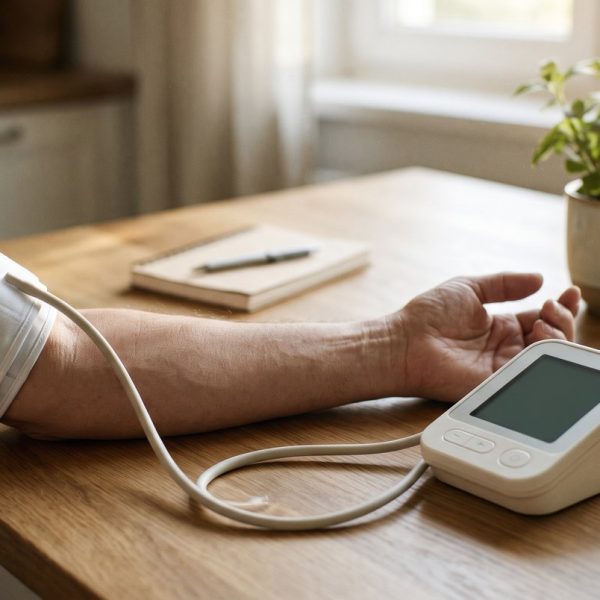
A single reading in a doctor's surgery is a snapshot, and often a distorted one. Many people tense up the moment the cuff goes on, and their numbers rise accordingly. Others have readings that look fine in the clinic but creep up during a stressful working day. That is why more doctors now ask patients to monitor at home. Learning how to check blood pressure at home properly takes about ten minutes, and it can give you and your doctor a far clearer picture of what is really going on.
This guide covers choosing a monitor, the routine that produces reliable numbers and how to make sense of what you see. It is general information, not a substitute for advice from your own doctor or nurse.
Why Home Readings Matter
Blood pressure changes throughout the day. It responds to sleep, caffeine, exercise, pain and stress. A series of readings taken at the same times over a week smooths out those swings and shows your true average. Home monitoring can also reveal so called white coat hypertension, where readings are high only in medical settings, and masked hypertension, the reverse pattern, which is easy to miss without home data.
For a clear explanation of how the measurement works and the different methods clinicians use, the Wikipedia article on blood pressure measurement is a good, well referenced primer.
Choosing a Home Blood Pressure Monitor
For most people, an automatic upper arm cuff is the best choice. Wrist and finger devices are more sensitive to arm position and generally less accurate. When shopping for a home blood pressure monitor, look for one that has been clinically validated; many national heart organisations publish lists of validated devices.
Cuff size is the detail people most often get wrong. A cuff that is too small can push readings up by several points, and one that is too large can bring them down. Measure around the middle of your upper arm and buy a cuff whose range covers that figure. If you buy a device online from another country, check that the instructions are available in a language you read fluently. Clear documentation is a regulatory requirement for good reason, as this overview of medical device translation explains.
Take your monitor to your next appointment and compare it with the clinic's equipment. It is a simple way to confirm it is reading accurately.
How to Check Blood Pressure at Home, Step by Step
Preparation matters as much as the device. Avoid caffeine, smoking and exercise for at least 30 minutes beforehand, and empty your bladder, since a full one can nudge readings up.
Sit in a chair with your back supported and both feet flat on the floor, legs uncrossed. Rest your arm on a table so the cuff sits at heart level. Wrap the cuff on bare skin, not over a sleeve, with the lower edge about two finger widths above the bend of your elbow.
Then sit quietly for five minutes. No talking, no phone, no television. Take two or three readings about one minute apart and record all of them, or the average if your monitor calculates it. Most clinicians suggest measuring in the morning before medication and breakfast, and again in the evening, for seven consecutive days before an appointment.
Understanding Your Blood Pressure Readings
Each reading has two numbers. The top figure, systolic pressure, is the force when your heart beats. The bottom figure, diastolic pressure, is the pressure between beats. Both are measured in millimetres of mercury (mmHg).
In the United States, the American Heart Association considers normal blood pressure to be below 120/80 mmHg. Readings of 120 to 129 systolic with a diastolic below 80 are classed as elevated, and anything consistently at 130/80 or above falls into the hypertension stages. Its chart of understanding blood pressure readings sets out each category clearly. Other countries use slightly different thresholds, so ask your doctor which targets apply to you.
A reading above 180/120 mmHg needs prompt attention. If it is accompanied by chest pain, shortness of breath, weakness, vision changes or difficulty speaking, call emergency services.
Keeping a Useful Record
A notebook works, though many monitors now store readings or sync them to an app. Whichever you use, note the date, time and any relevant context, such as a missed dose or a poor night's sleep. Bring the full log to appointments rather than just the highest or lowest numbers.
Small Habits, Better Numbers
Home monitoring works best alongside the everyday choices that support your heart: regular movement, less salt, moderate alcohol and enough sleep. For a practical overview of those foundations, this guide to heart health basics is a useful next read. Measured consistently and shared with your care team, a week of home readings is one of the simplest and most valuable things you can do for your long term health.